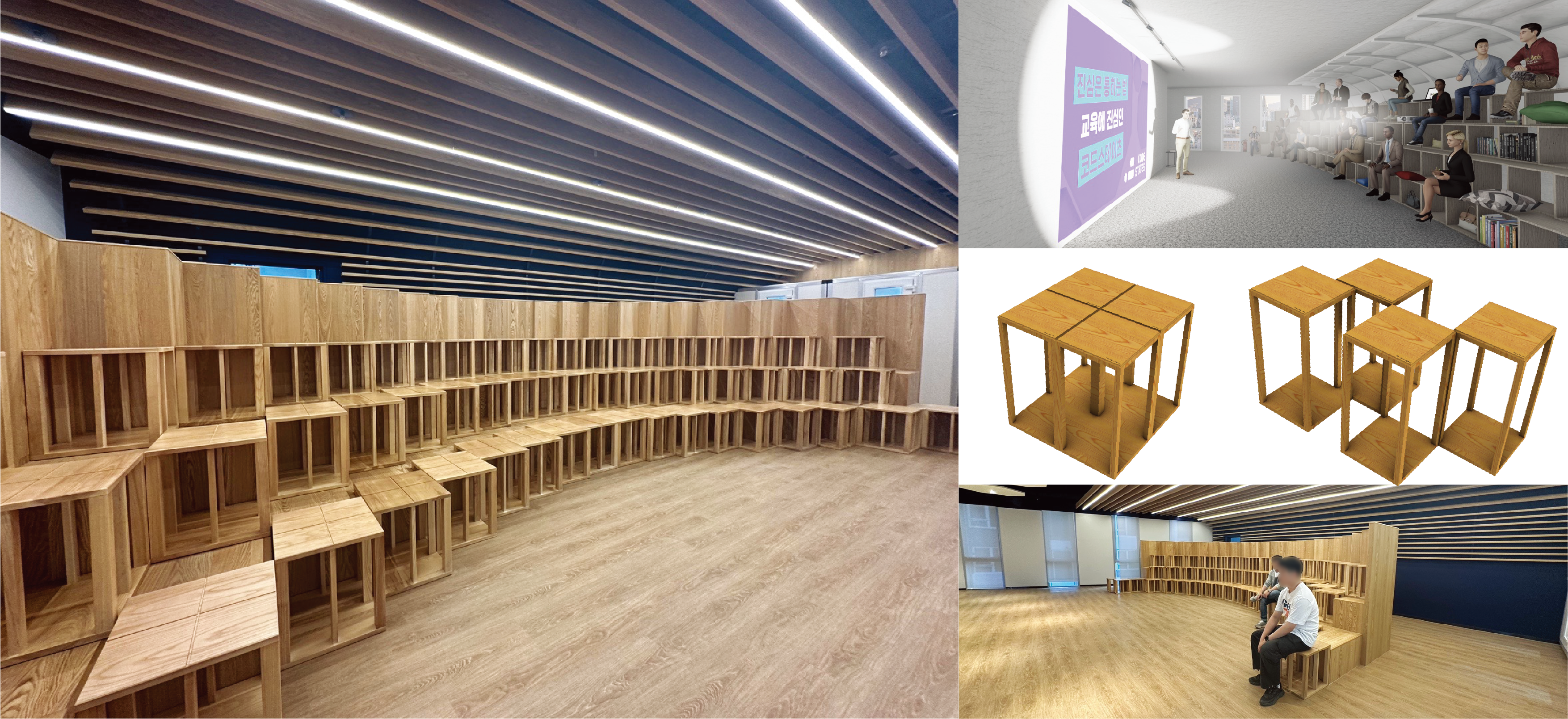
This project was part of an interior design initiative for Code States’ headquarters, specifically focused on a custom pavilion furniture system for the Town Hall space. I participated in all stages of the project—from the early conceptual phase to design development, 3D modeling, visualization, and construction coordination.
The Town Hall serves as a multifunctional large space where employees gather for informal meetings, relaxation, and small-scale lectures. The client requested a pavilion that would embody the unique identity of Code States while also serving as a meaningful and transferable design asset—something they could carry with them as the company expanded into a new headquarters.
With this in mind, we developed the concept of "Legacy." The pavilion was designed as a modular system, composed of 250 individual modules, each engraved with the name of one of the 250 Code States employees. These modules symbolize collective memory and the company’s shared journey. Each module, measuring 250×250×500 mm, combines in sets of four to form a single chair. Multiple chairs can then be assembled into a pavilion structure. Magnetic inserts were embedded in each unit to allow for intuitive, tool-free connection and reconfiguration.
Ultimately, when Code States transitions to a new office building, this modular pavilion can be reassembled and displayed at the main entrance—as a sculptural tribute to the company's history and the individuals who shaped it.
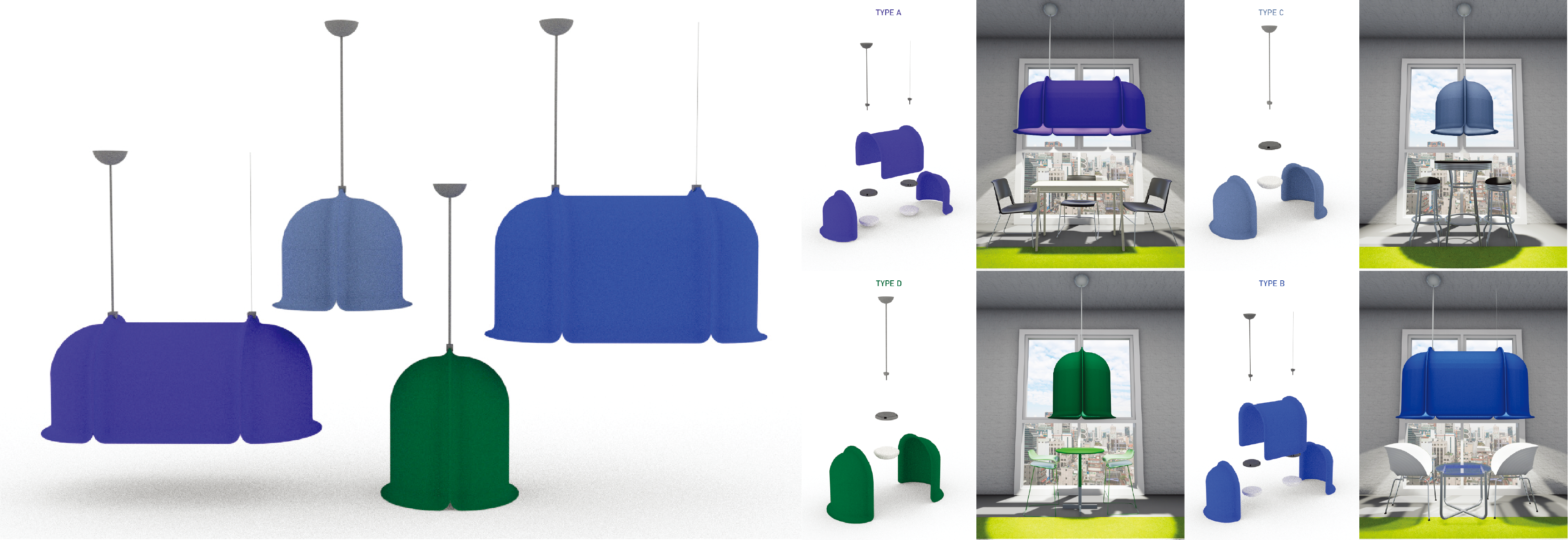
As part of an open-plan office environment at Code States, this lighting fixture was designed to support private activities and small meetings within a spatially unrestricted layout. I contributed to the initial concept and design development, and was fully responsible for 3D modeling and visualization.
Inspired by existing furniture forms, the lighting fixture was developed through a series of formal transformations, resulting in a design that aligns with Code States’ identity and philosophy. In an office without physical partitions, the fixture acts as a tool for creating semi-private zones. Its height-adjustable structure allows users to adapt it to various activities, such as focused work, quiet conversation, or informal discussions.
The fixture is designed not only to reflect sound inward, promoting better acoustic conditions, but also to concentrate light downward, thereby establishing a visual and functional boundary without the need for walls—creating a sense of enclosure and spatial identity through light and form.